
Retrospectives
Temple of the Dog and Turning Grief into Something Beautiful
Prompted by a class called "Mixtape Memoirs," I've begun to revisit some of the music that has shaped my life. For the first time, I write about my Seattle relocation following profound trauma and grief, and then how Temple of the Dog pointed me in the right direction.
“Remember, you just got out of a cult. A lot of feelings you have are a product of your three years there… Keep telling yourself this. I promise it will get better.”
Recently, I finished a class titled Mixtape Memoirs. For the first time since my move to Seattle, I'd written (and spoken) openly about my relocation. It's never been easy to talk about, but I've finally grown more comfortable with putting my experience into words. However, it's still very hard to define. How do you define the undefinable?
For nearly three years, my life in Seattle has been an exercise in transmuting grief, anger, and joy into something new. I've been in bloom, a constant work in progress, for quite some time. My healing process has been aided by reintroducing myself to the concept of community, and also a lot of great music along the way. So, naturally, a Mixtape Memoir class called to me. I've been wanting to tell my story, and it's only fitting that I do so through the songs that defined me.
Following the last session of my Mixtape Memoir class, I joined a new friend for a spontaneous karaoke adventure in Columbia City. We sang along to Alanis Morissette's "You Oughta Know," and while it was vocally distressing, it was cathartic singing at the top of my lungs with other strangers. My last relationship ended a while ago, but I felt the betrayal and angst that Alanis so expertly conveyed. I found it incredible that in a moment, I was purging emotions with a crowd of people I didn't know, alongside a new friend, who is also learning to write out her grief.
After my night ended, I continued to think about the soundtrack of my life. For some reason, in class, I was apprehensive about naming local music inspirations. Once upon a time, they were larger-than-life figures far, far away. Now, they exist somewhere nearby, now close to where I also call home. I'd named a couple of songs for my final assignment, but I'd left a glaring void. For a 10-page piece, it's nearly impossible to cover everything.
While I sang karaoke, I was reminded of some other music that meant a lot to me, and another special moment prompted by Temple of the Dog.
I relocated to Seattle from Los Angeles County on July 12th, 2023. I left a strange, high-control environment, some may call it cult-like. Following three years of constant pressure, emotional abuse, and exploitation, I was trying to figure out my place in the world again. My first months in Seattle were among the most taxing and incredible of my life.
Free from any major work obligations (besides a part-time editing gig), I was able to roam about the city and finally enjoy things I loved again. I didn't have an exact purpose for relocating to Seattle. I mainly just wanted to rest and exist without any strings attached. I was also fueled by a desire for a clean slate and a place that wasn't as chaotic for me. For years, I'd been in love with the whimsy and greenery of the Pacific Northwest. I loved the music too, but saw it as a perk. After talking myself out of moving to Portland, I saw Seattle as the next adventure.
About two weeks after I arrived, I saw that one day, there was a Brad record signing at Easy Street (for their final album In the Moment That You're Born), and the next day was The Rockfords' first live show in over 20 years at the Showbox. As a Pearl Jam and Northwest music fan, it was a dream come true. And naturally, the events drew a bunch of Pearl Jam pilgrims from all over. However, I was still nervous since I was a baby in the city. Luckily, an online friend connected me to someone who traveled to Seattle for the weekend. Strangely enough, I had stood behind this woman at a Painted Shield show just a couple of months earlier. I didn't know her then, but music would bring us together once more.
After standing like cattle for slaughter for some signatures, I came back to Earth. I couldn't believe I looked dead into the eyes of people I admired and managed to get any words out. I was too awestruck to even ask for selfies, as my friend did before me. A lot is a blur, but I remember after I gushed, there was a sweet, genuine smile, "Thanks for listening," and then continued the human conveyor belt.
After the Brad signing, my new friend and I were invited over to Talerico's for pizza and karaoke. I didn't really know anyone else, but I knew that we all shared a love of the same band. Everyone was friendly and welcoming, and very excited about my newness. We all squished at a table together and took in the hilarious sights of drunk people belting out top 40 tunes.
One of the women in the group chose a song for us to sing. Not surprisingly, she chose "Hunger Strike," a karaoke favorite among grunge fans. We needed to sing "Hunger Strike" for some reason. And similarly to when I sang along with Alanis, I nearly broke my vocal cords trying to teeter-totter between Chris Cornell's impassioned high notes and Eddie Vedder's gravelly crooning. We sounded horrific, but it was a beautiful moment all the same.
The same woman who selected the song stated she would send the video to a certain someone for a specific reason. She insisted it was a "surprise." She typed all of our names and delivered the video of our botched version of "Hunger Strike" to her friend. She needed him to see our singing.
The very next day, that someone would go on to sing solo on stage for the first time. That song happened to be the first glimpse of his rock opera, his years-long manifestation of grief, love, community, and music. And then, I realized we‘re all dealing with our own pain in our own ways. We all wear grief differently.
It was an oddly poetic moment, and one that reminded me that I was going to be OK.
Some of those people in my group I would meet formally later. And now, nearly three years after my move, I’ve been creating again. For a really long time, I stepped away from writing or any sort of creative output. I had been surviving for so long that I lost myself and my purpose.
I've spent a lot of time pondering grief, music, and how something beautiful can arise from those things. As far as my life and all the people I have encountered, I still struggle to define anything. Yet, I've thought that what defines a person is not the shitty things that happen to them. What defines a person is what they choose to do with the grief that seeps through the shit. Grief is a fertilizer. You can either let it collect and stink or use it to grow something new, maybe something that will nourish others.
Often, I am reminded of Temple of the Dog and the beautiful music that arose following an insurmountable loss. Released in 1991 after a two-week recording process, it's one of the most profound examples of what happens when you channel grief and use that to fertilize a whole garden of joy. 35 years later, people still sing "Hunger Strike" off-key in bars, shout in a crowd of people to "Reach Down," or cry in solitude to the poignant lyrics of "Say Hello 2 Heaven." That garden still sustains millions and has even multiplied many times over.
Temple of the Dog (the band and the record) exists as a testament to the beauty of Chris Cornell and Andrew Wood, and also the healing power of music and art as a whole. It helped me to re-envision what it means to go on after the undefinable happens. And through time, I’ve fallen in love with Seattle and the camaraderie of the community here. Constantly, I see examples of people who have chosen to still create and have also chosen beauty and kindness despite the tragedy, obstacles, and even cruelty hurled their way.
Two months after my West Seattle karaoke adventure, I would finally pay a visit to Discovery Park for the first time. It took a while to build up the strength to make the hike, and I wanted it to be meaningful for my first time. Although I had moved to Seattle in July, I was still dealing with the fallout of leaving my toxic situation. I had hit a mental low and questioned my existence. I hid behind cinematic "I made it posts!" but each day was a struggle to live.
The "Hunger Strike" video inspired me to make the pilgrimage to Discovery Park, as so many others had. To many (or maybe me), the video embodies a release. I decided to orchestrate my own, even though I can't sing or play instruments.
The trip to Discovery Park takes nearly an hour by bus, and the endpoint is a nearly 40-minute walk from the nearest bus stop. It's not for the impatient, and it's not for a quick trip or photo op (at least in my case).
For me, the trek was arduous and painful, but when I reached my destination, it was worth the effort. There was a beautiful view of the bay, and a few boats floating by. There was barely anyone there, ideal for an introvert looking to mull things over. The air was peaceful, and the winds were still.
While I rested on the beach, I decided to revive a ritual from my youth ministry days. I sat in solitude, meditating as the waves crashed. When I came to, I pulled out a paint pen and selected rocks to write on. With the pen, I wrote on each rock something I needed to release. There were a lot of rocks, and I purposefully picked some heavy ones. Then, after uttering affirmations to myself, I cast my pile of rocks into the ocean, allowing them to be swept away.
After that, I chose to move forward and was reminded that, in times of trouble, you can break through.
I saw you swingin', yeah, swingin' your mother's sword, ooh
And yeah, yeah, yeah, I know you're playin', but oh, sometimes the rules get hard, oh-oh-oh-oh-oh
But if somebody left you on out on the ledge
If somebody pushed you, you're over the edge
If somebody loved you and left you for dead
You gotta hold on to your time and break through these times of trouble

Loosegroove Records Reintroduces the "Nutty Nut-Meg Phantasy" of Weapon of Choice
Loosegroove Records digs into its archives with a re-release of Weapon of Choice's "Nutty Nut-Meg Phantasy," a trippy smorgasbord of sound and visuals.
Loosegroove Records is in the midst of a revival, but along the way, it's taken an adventure through its catalogue to reintroduce one of its earliest releases. Recently, the label debuted a new rendition of the song "Nutty Nut-Meg Phantasy," from cult favorite signee Weapon of Choice. The song appears on the band's 1994 debut album, Nut-Meg Sez "Bozo the Town."
The Southern California-based band was founded by bassist Lonnie "Meganut" Marshall in 1992 and gained immediate attention through its trail mix of funkadelic grooves, heavy basslines, and lively shows. The collective of musicians garnered comparisons to Fishbone, Sly and the Family Stone, and Parliament.
A more recent description of Marshall's music is "authentic, original alternative funk. Positively playful, humorous, catchy, and magical sound, that soothes, grooves, and moves the soul..." Marshall even coined the term "nutmeg" for the band's signature sound.
In recent years, Loosegroove has collaborated with Marshall for Painted Shield's "Lover Divine," a video which he animated and directed. He also released a single, "Parking Lot," through the label in 2022.
Nut-Meg Sez "Bozo the Town" follows the story of its central character Nutmeg, who is an intergalactic being whose mission on Earth is to encourage people to “live beyond and outside the boundaries of your south-central nervous system."
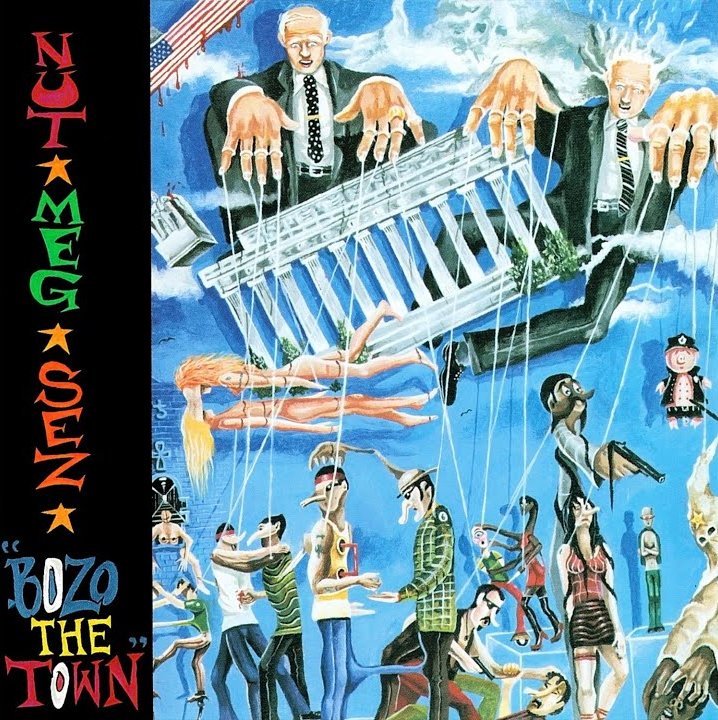
The latest version of "Nutty Nut-Meg Phantasy" was remixed by Josh Evans (Pearl Jam, Brandi Carlile, Soundgarden).
"Nutty Nut-Meg Phantasy" is a cosmic love song inviting listeners into Nutmeg's cartoon universe filled with "chocolate-covered roses and love in massive doses." A funky frolic through time and space, Nutmeg promises a sensual ride to Cloud Nine, then on to the moon. You never need drugs to take a trip to the funky phantasies of Nutmeg, but you're free to use if you choose...
The single is now accompanied by a brand new music video, a trippy smorgasbord of sound and visuals that brings Nutmeg to life. The video is a combination of archive footage of Weapon of Choice, Marshall's psychedelic animations, and bits of Marshall himself.
For more information about Weapon of Choice and Lonnie Marshall's other projects, visit meganutmusic.com.

The Alchemy of Mad Season's 'Above'
30 years after its initial release, Mad Season's 'Above' exemplifies what it means to follow the higher calling of an artist.
Music, in itself, is a transcendental medium. In its purest form, it can provide an otherworldly experience that exorcises emotions, and lays down a path for healing. It also brings people together from all walks of life. Not everyone recognizes this power, but those who do, understand the higher calling of being an artist. Nineties Seattle was a breeding ground for creative alchemy, but one of the finest examples was Mad Season's singular album, Above.
30 years later, Above has retained its status as one of Seattle's most important musical contributions. Released in 1995, the album represented a tonal shift that would define the rest of the decade. At the decade's midpoint, the grunge luster was wearing off and many of the bands' music was becoming more defiant, apprehensive of fame, capitalism, and their effects. Out of the chaos, Mad Season arose.
My best memory of Layne was when we were making the "Above" album."He was in the studio lounge reading Kahlil Gibran's "The Prophet." I had read it a few years earlier, so we started talking about what it meant to be an artist and have a spiritual message. I don't need to get into the specifics of the conversation, but suffice it to say that Layne Staley felt as though he was on a spiritual mission through his music. Not a rock mission, a spiritual mission. And I think that is evident in his words and in the timbre of his voice. When you hear it, you know it. He was an authentic artist in a time of imposters. - Barrett Martin
Mad Season's original lineup included guitarist Mike McCready (Pearl Jam), percussionist Barrett Martin (Screaming Trees), vocalist Layne Staley (Alice in Chains), and bassist John Baker Saunders (Walkabouts). McCready and Saunders met at a rehab facility in Minnesota, then recruited Martin upon their return to Seattle. Lastly, Staley was brought on board not only to round out the group but because the other members thought it would be a space to encourage his sobriety.
Originally named the Gacy Bunch, the group renamed themselves Mad Season, which was derived from an English term for when hallucinogenic mushrooms reach full bloom.
It seems that Above was created in a whirlwind. Recorded in about two weeks following only a handful of shows, Above was a rainbow among the storm brewing in Seattle, when lightning in a bottle phenomena were happening regularly. As quickly as Mad Season appeared, they were gone, but it was a sight to behold while the band did exist, and left a beautiful residue in its wake. It's a testament to what happens when community joins together in pursuit of something greater.
Going in, I knew that listening to Above was not going to be an easy experience. While I love the album, it became synonymous with a difficult breakup—a breakup with a person who struggles with addiction, at that. Any time I listen to Mad Season, I am forced to reckon with the repressed emotions that accompany loving someone I wanted to save from themselves.
The album opens with "Wake Up," a harrowing plea. The first line, "Wake Up," is an immediate call to action. With minimal instrumentals in its first minutes, Staley's voice barrels out of the sound system, which feels eerie as he sings the poignant lyrics "For ten long years... The leaves to rake us... Slow suicide's no way to go..."
The beauty of Mad Season is that the band allowed Staley full creative license to just... be. "Wake Up" allows Staley's vocal power to shine. McCready, Martin, and Saunders take their time playing, following Stayley's lead. "River of Deceit" equally as powerful as "Wake Up," allows Staley to showcase his songwriting skills.
My pain is self-chosen
At least so the prophet says
I could either burn
Or cut off my pride and buy some time
McCready's frenzied shredding builds up as Staley reaches a crescendo. Known for his explosive solos, McCready is completely unhinged throughout Above, but in the best of ways.
The band is joined by Mark Lanegan (Screaming Trees) in "I'm Above" and "Long Gone Day." Lanegan and Staley's harmonizing is hypnotic. Lanegan's smooth whiskey baritone voice always evokes a sense of nostalgia. I've even heard his voice described as the perfect companion for a long, winding road trip, as wherever you need to go, Lanegan's voice "will get you there."
"November Hotel" is a magnificent jam session that is the epitome of creative serendipity. Without lyrics, the song is merely an explosion of each musician at their best. It's a manifestation of years worth of frustration, a musical exorcism. It's joy and anger all rolled into seven minutes of whiplash. Like an airplane, McCready's riffs take off, soaring above Martin's percussion. One of the unsung musicians of the Seattle scene, Martin is a spectacle as he unleashes (he also plays cello, marimba, and other percussion on the album). Saunders is also underrated, as his heavy bass line is like a pulse.
The album ends gently with "Alone," following the fire storm that is "November Hotel." Simple and understated, "Alone" seems meditative, but not cynical. It's a comedown from the musical high.
In an interview with the Seattle Channel's Art Zone, McCready speaks on the formation of Mad Season and his naivety in trying to help his bandmates achieve sobriety. Speaking from experience, you can try to do everything in your power to help someone, but in the end, they have to decide to change. It's a bittersweet revelation, but Above inspired many individuals to make that big decision.
Layne Staley achieved his mission.
In terms of spirituality, when someone becomes a vessel for change or spreading a message, they are not always perfect. In fact, their humanity is what endears them to the masses. Mad Season's Above was a one-time occurrence, but it continues to deliver its message 30 years later. Luckily, McCready and Martin are still spreading the message in their own ways. Staley, Saunders, and Lanegan are no longer with us, but their music remains. The immortality of Above lies within the bravery and vulnerability of its members. The path of an artist is the road less traveled by, but Above shows us that we aren't really alone. There are other voices out there that can take us down the crossroads.

Celebrating the Feminine Rage and Despair of Hole's 'Live Through This'
No matter its origin or surrounding lore, Hole's most notable album has become synonymous with powering through the chaos of life. For 30 years, Live Through This has been the epitome of feminine rage and despair.
As I ponder the timing of the release of Hole's Live Through This, it seems like a cosmic joke. On April 8th, 1994, the Earth stood still as the news of Kurt Cobain's untimely passing rippled through the Universe. It was an event that rerouted the course of music history, causing a media firestorm that still burns today. Released just four days later, on April 12th, 1994, Live Through This seemed like a direct response to the occurrence, however, it wasn't—contrary to popular belief.
Live Through This is stated to be derived from a line in Gone With the Wind. Standing on top of the ashen wreckage of her plantation, Scarlett O'Hara proclaims, "As God is my witness they're not going to lick me. I'm going to live through this and when it's all over, I'll never be hungry again. No, nor any of my folk. If I have to lie, steal, cheat, or kill. As God is my witness, I'll never be hungry again."
O'Hara's words are incendiary—lit by a match of spite. She decrees that she will survive regardless of the obstacles, and thrive afterward by any means necessary. It's a pretty fitting declaration for frontwoman Courtney Love, who clawed her way from tumultuous beginnings to rock superstardom. Whether you love her or hate her, there's no denying Love carved a space for herself in pop culture.
No matter its origin or surrounding lore, Hole's most notable album has become synonymous with powering through the chaos of life. For 30 years, Live Through This has been the epitome of feminine rage and despair. Constantly pilloried, yet constantly emulated, Love was appointed patron saint of pissed-off women worldwide, as she was a mouthpiece for those who often couldn't outwardly express their own anguish—myself included.
Live Through This helped fuel my own "as God as my witness" moment, becoming a more potent influence in my life than ever before. The words always resonated with me but mutated into an anthem of survival and defiance as I embraced the rage that fueled my will to live again. Sometimes spite is that one little push that helps you move forward.
At its release, Hole's members included Love, guitarist Eric Erlandson (who also often co-wrote), drummer Patty Schemel, and bassist Kristen Pfaff. Pfaff brought the professionalism needed to craft Hole's new sound. While both albums are often considered part of the "grunge" movement, Hole's debut Pretty on the Inside was an audio diary inspired by noise and punk, and Live Through This is slightly more polished for mainstream appeal, packaging Love's frenzied wails and the band's feverish instrumentals with beauty pageant, doll-inspired, and pastel candy aesthetics.
Semi-autobiographical, Live Through This was mined from Love's experiences with toxic relationships, being vilified by the press, her launch into motherhood, and the insecurities of being with a partner who was a larger-than-life figure. At the time, Love created songs about subjects largely glossed over by her male contemporaries. On the album, Love's genius was able to shine on its own accord, forever branding herself as "The Girl With the Most Cake."
Live Through This opens with the soul-splitting "Violet," an ode to a tumultuous relationship and sexual exploitation. The twenties-inspired video follows the same themes, juxtaposing strippers with young ballerinas, who are both leered at by suited men. "Violet" is a lightning strike as Love screams "Go on, take everything, I want you to.." inviting listeners into her pain. To this day, as I listen to "Violet," I feel a curdle in my stomach when I hear "Might last a day... Mine is forever..." To me, it's a song that captures the emotional scars left behind by a bitter breakup.
"I'm Miss World, watch me break and watch me burn..." The album doesn't ease up as it moves forward to "Miss World," which hides dark lyrics under an upbeat melody and the glitz and glam of pageantry. The song laments trying to uphold beauty standards and engaging in self-destruction. On-screen, Love stands in front of a glittering sign, "Cleanliness is close to Godliness," hinting at the pursuit of perfection.
As Live Through This continues, Love's body is a battleground—whether it be due to motherhood, substance abuse, societal expectations, or sex. "Plump" details Love's experience with pregnancy and post-partum depression. Love's role as a mother is also referenced in "Softer, Softest," and "I Think That I Would Die." The biting "Asking For It" is a song that deals with rape, both in the physical and metaphorical sense.
The most successful song on Live Through This is "Doll Parts," in which Love takes on a more melancholy tone. Known for her biting lyrics and rage, "Doll Parts" takes time to despair over the insecurity of being with someone (that someone being Nirvana frontman Kurt Cobain) that the whole world seemingly desires. Love takes a step down and allows herself to exhibit a longing that isn't quite present in earlier work.
Vulnerable and sharp, Love spills her guts between the notes of Live Through This. For a little while, one of the most famous rock stars ever comes down to Earth. The sad reality of Live Through This is that as women, most of us share the same experiences. Whether it be on a small scare or a large scale, you're under a microscope.
With her private life on display and ripped apart, it's still baffling that Love and Hole were able to power through motherhood, fame, and tragedy to create something that has withstood the test of time. Despite the obstacles thrown Love's way, Live Through This showcases resilience. It says, "I'm still here and I'm not fuckin' leaving."
Because of this album, so many others have made the same declaration.

Revisiting Soundgarden's 'Superunknown'
March 8th, 2024 marks the 30th anniversary of what's considered Soundgarden's breakout album, Superunknown. For me, Superunknown was one of the gateway albums to my love affair with rock music.
March 8th, 2024 marks the 30th anniversary of what's considered Soundgarden's breakout album, Superunknown. For me, Superunknown was one of the gateway albums to my love affair with rock music. I don't remember exactly how I found it, but I recall seeing "Black Hole Sun" in my YouTube recommendations back in 2009 (?) as a junior in high school. Although I don't remember the exact year, I do know that I had some downtime during my Drafting class and was dilly-dallying online, watching '90s music videos. At that point, I'd found a lot of music through my mother (a true Gen X-er), but I can say that Soundgarden was one of my first independent discoveries.
Once I saw the brightly saturated colors of the suburban cult and the deliciously demonic visuals that accompanied Chris Cornell's low, slow snake charmer voice, I was hooked. "Black Hole Sun" is something I can only describe as the audio equivalent of taking mushrooms on a 110-degree summer day in Southern California... or maybe the sound conjuring of Salvador Dali's The Persistence of Memory. It's a trip that starts blissful and bright then descends into an apocalyptic frenzy where you can't help but wonder if the end is nigh.
15 years have gone by, and it's been a very long time since I've listened to Superunknown all the way through. When it comes to Soundgarden, Screaming Life is my go-to. However, I recently decided to revisit the well-known Superunknown once more.
Following the massive 1992 Lollapalooza tour supporting the release of Badmotorfinger, Soundgarden started crafting their album in the hopes of exploring new sounds. Arduously recorded in 1993 at Seattle's Bad Animal Studios with the steadfast guidance of Michael Beinhorn, Soundgarden drifted away from its early punk influences and created a 70-minute behemoth that's powered by complex arrangements and the combined lyrical and composing prowess of bandmates Chris Cornell, Kim Thayil, Ben Shepherd, and Matt Cameron.
Marking its fourth studio album with Superunknown, Soundgarden pushed the boundaries of its musical horizons. Already a band for nearly a decade during the album's release, Soundgarden's ascent to rock superstardom was a steadier one than that of their hometown peers. Following the heavy and raging in-your-face tunes of Badmotorfinger, Superunknown emerged more polished and tinged with despair and psychedelia—which was a winning recipe that led to the band's most recognized work. Superunknown was also more radio-friendly and "palatable" for heavy MTV airplay than the band's earlier works, which were considered to be metal. With the increase in exposure, Soundgarden's journey on the snake mutated into an anaconda that wound itself tightly around the music industry and fans around the world. After 30 years, we're all still feeling the squeeze.
Superunknown opens with the punchy "Let Me Drown," which continues the theme of Soundgarden's references to religious visuals, ones of which were previously peppered throughout the Badmotorfinger era (most notably with "Jesus Christ Pose"). Fueled with frustration, "Stretch the bones over my skin... Stretch the skin over my hand... I'm going to the Holy Land" is a hell of an intro.
Following "Let Me Drown," Superunknown veers into a moody epic that experiments with hard riffs, powerhouse percussion, and Cornell's hypnotic vocals. Cornell, Thayil, Cameron, and Shepherd all make major contributions, switching on songwriting (and sometimes singing) duties and utilizing other instruments such as keyboards, viola, and even spoons.
The first song leads into the anthemic "My Wave," before going to the melancholy "Fell on Black Days," which slowly ponders the impending doom that exists in the universe.
As the album trudges on, Soundgarden's lyrics point to disillusionment with society through songs like "Mailman" and "Head Down." The title track, "Superunknown," is a bit more optimistic and esoteric in its urge to listeners to change their perspectives on life. A lot of our existence is indeed unknown, but it's up to us to make the most of it... At least that was my interpretation of the lyrics. "If it isn't making sense... Yea, it doesn't make it lies..."
Near the halfway point, Shepherd's catchy "Head Down" transitions into the trippy wasteland of "Black Hole Sun." After that, Superunknown rocks on with "Spoonman," "Limo Wreck," "The Day I Tried to Live," and "Fresh Tendrils." Throughout the album, Soundgarden presents songs that tackle depression, frustration, isolation, and conformity. With many nods to water in the lyrics, the music flows during the 15 tracks, sometimes like a gentle stream, and others like an angry waterfall.
My favorite song on the entire album is "4th of July," which is a sludgy tune that signals the coming rapture alluded to in the album's earlier songs. "4th of July" is dark and sinister, painting a picture of a Biblical occurrence akin to that in the book of Revelation. As I mentioned "Black Hole Sun" is a mushroom trip, "4th of July" is a trip gone completely awry. Luckily the dreary song is followed by the mellow Indian-inspired "Half," (another Shepherd-dominant track) which marks a comedown back to reality.
Superunknown closes with the contemplative "Like Suicide," which drew inspiration from Cornell's experience of finding a dying robin by his window. The song eulogizes the robin, which can be seen as a metaphor for how we all fly through life and tend to crash into things, and for the fleeting nature of life and how we all continue to soar... until that time comes to an end. Superunknown then fades, leaving listeners with something to ponder.
One of the defining albums of the '90s, Superunknown has withstood time and continues to resonate with younger music fans like myself, as well as those who were with Soundgarden in its Seattle infancy. Although Soundgarden wasn't seeking mainstream success, the band stayed true to themselves and put craft above all else, which led to an album that changed music history.
