

Music is the Answer in 'RADIOHEART: The Drive & Times of DJ Kevin Cole'
Known for his endless championing of artists and in-depth conversations about craft and life, DJ Kevin Cole's work embodies music as medicine. 'In RADIOHEART: The Drive & Times of DJ Kevin Cole,' he finally takes a turn as subject.
If there ever was a presence to keep you company en route to your destination, it's DJ Kevin Cole. Whether you're stuck in Seattle's rush hour traffic or decompressing thousands of miles away, you can count on Kevin to be your musical tour guide.
The warm and welcoming steward of KEXP's Sunday "Variety Mix," and formerly "Drive Time," DJ Kevin Cole, has spent decades on the airwaves, sharing his love of music from and to all corners of the globe. Known for his endless championing of artists and in-depth conversations about craft and life, Kevin's work embodies music as medicine. To me, Kevin has been a towering figure in the Seattle music scene, but I am glad I finally learned more about the life behind the voice. Until now, I'd enjoyed his Sunday show on occasion and appreciated his pure enthusiasm for music, old and new, and storytelling on social media.
In RADIOHEART: The Drive & Times of DJ Kevin Cole, Kevin finally takes a turn as subject. In the new documentary directed by Peter Hilgendorf and Andrew Franks, Kevin's storied career is carefully explored. The feature traces Kevin's Minneapolis beginnings at First Avenue to his founding of the alternative radio station REV105, then his stint at the then-blossoming Amazon music store, to his current home at KEXP (formerly KCMU).
Originally intended as a short video celebrating Kevin's retirement from a 50-year music career, the DJ's life demanded a feature treatment once the interviews started rolling in. Who else do you know who was spinning at Prince's private parties back in the day? And what a vast life change between the eclectic underground scene of the Twin Cities and the tech industry beast in '90s Seattle!
The life and times of DJ Kevin Cole could probably fill several documentaries, honestly, but directors Hilgendorf and Franks manage to condense Kevin's story to a little under an hour and a half. Interspersed with archive footage, animation (by Eric Kassel), and an amazing soundtrack, RADIOHEART does Kevin justice.
Among the luminaries and artists who appear in the documentary are Kevin's partner, Shawn Stewart (REV105, KMTT, WXPN), Bob Mould (Hüsker Dü, Sugar), Jessica Dobson (Deep Sea Diver), Megan Jasper (Sub Pop Records), Matt Vaughn (Easy Street Records), Andy Jassy (Amazon), Steve McClellan (First Avenue), and Kevin's fellow KEXP DJs, John Richards, Cheryl Waters, and Eva Walker.
While many documentaries about seminal figures focus on the mythology of their subjects, RADIOHEART is not afraid to show Kevin's vulnerabilities alongside his accomplishments. In between Kevin's career milestones, the film gets candid about his battles with addiction and depression. Kevin, among his vast record collection, demonstrates an astounding amount of self-reflection on the opposite side of the mic. However, the film takes an optimistic route by celebrating Kevin's journey to sobriety and his healing through music, and how he, in turn, helped others on their healing journeys.
As much as RADIOHEART is an ode to Kevin, it is an ode to the art of radio itself.
In an increasingly algorithmic and automated world, RADIOHEART amplifies the importance of humanity in curation and music discovery. What often makes radio special is the ability to connect with listeners. To me, the beauty of new music is when a person shares why it matters and how it makes them feel.
For instance, a major section of the documentary is dedicated to Kevin's passion for Icelandic music. Inspired by the work of Sigur Rós, Kevin embarked on a mission to the island to share its artists and culture with the world. Since then, he has been a staple at the Iceland Airwaves music festival and has recorded over 300 sessions with Icelandic artists. One of the most notable success stories is Of Monsters and Men, whose videos on KEXP's YouTube went viral. To date, their videos are some of the most viewed, and the band has since signed with Universal and toured worldwide.
At the same time, the documentary serves as the story of beloved institution KEXP.
The film presents KEXP's rise from a scrappy college radio station to a global platform that pioneered internet streaming, the two-week show archive, and live performance broadcasts. An independent organization, the station's DJs have the freedom to curate their own sets. And unlike most commercial stations, KEXP's DJs delve into the hard topics that most other stations shy away from on air. Additionally, the station continues to break new artists locally and from abroad. It has also become a popular tour stop for visiting musicians.
There is no way to mention KEXP's growth without Kevin. Through his passion for spreading the gospel of good music, he has helped the station remain a mainstay online and on local dials. Luckily for me, as a Seattle resident, I am glad I can exist in the same space as both.
Although DJ Kevin Cole has retired from his daily show duties, he still hosts "Variety Mix" on Sundays. But with so much musical joy to spread, how can one be truly retired?
For more information about Radioheart and where to catch upcoming screenings, visit Radioheartfilm.com.

Seattle Times Aftermath and What's Next
I reflect on my profile in The Seattle Times, affordability as an artist, the city's music community, and what's next for me.
Over the past week, I somehow ended up on the cover of a Sunday edition of The Seattle Times. I absolutely did not expect it. In the wee hours of the morning, I checked the paper's digital version. My stomach was tight with anticipation, and when the final publication was revealed, I gasped and immediately cried.
The tears weren't of joy; they were of anxiety. I felt like I was naked and exposed in the town square. When I first submitted to The Seattle Times' call for experiences on surviving in the city, I thought I would be a passing sentence among a chorus of voices. However, I was told I'd be profiled. At that point, I was thinking I'd be somewhere in the back, wedged between some grocery store coupons. Then, later, I was frozen in time on the front page under the headline, "LIVING IN SEATTLE ON $60K COMES WITH UP TO 7 ROOMMATES."
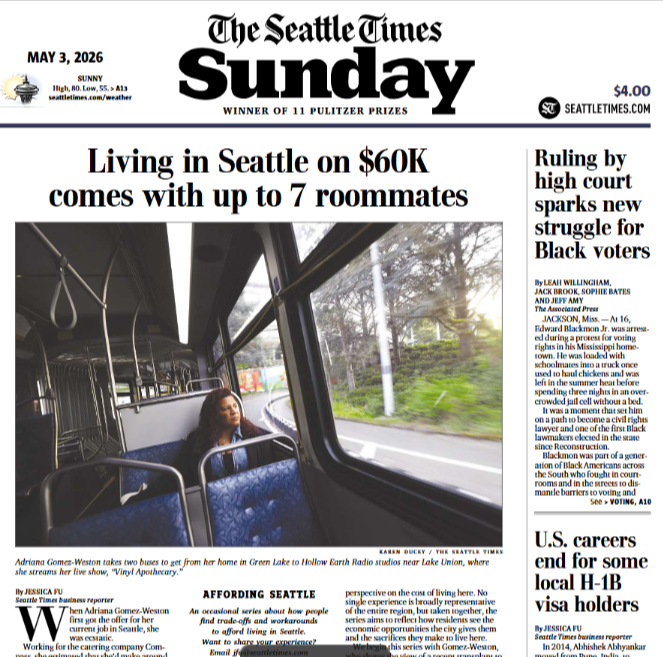
Yeah, it is true, but it felt so sobering seeing it in actual words. The last thing I wanted to be was seen as "needy." Actually, I think a part of me was afraid of being seen at all. A lot of times, I associated visibility with feeling small and vulnerable.
As the morning rolled in, I decided to send the links and screenshots to my closest family and friends anyway. Right away, everyone was supportive and really excited. They didn't seem to care much about the headline, more that I was speaking out about the cost of living and being a creative. My sister helped calm my nerves, and I allowed the story to unfold.
The past week has been interesting, to say the least. I saw the article travel online, reposted on the Seattle Times' socials, by my favorite record label, local colleagues, civic organizations, and even Seattle's mayor, Katie Wilson. For the most part, the responses were positive (with the occasional boomer criticisms). People sent me words of encouragement, housing leads, comped show tickets, and overall agreement with the state of Seattle's creative economy.
Sadly, Seattle's cost of living has skyrocketed, making it difficult to build a life as a creative. The city prides itself on its contributions to pop culture, namely music, but it has sidestepped what made all that possible in favor of the tech industry. The music industry here, specifically, is chock-full of talent and wonderfully diverse, but woefully underserved and underpaid in most cases. And even worse, many people considered music pioneers and cultural contributors are struggling to make ends meet themselves, many moonlighting at some unremarkable day job.
I can't say it's a relief that a lot of people are in the same boat, but it made me feel less alone in my struggle. For the working-class artists, it's like we're all playing hot potato with the few dollars we make. There's also this knowing between all of us. This week, more than I have felt in a long time, I was seen.
Regardless, since I've moved here, and even more now, I've been moved by how the creative community has come together. I had a lot of conversations this week about affordability, music, and life overall. It somewhat cured my perpetual wallflower status. I feel like I've been hiding in plain sight until recently, since I never wanted to be a "bother" in any way, and often preferred to observe the rooms I was in. I learned that most people are amiable and welcome enthusiasm and conversation.
After the whiplash of the past week, I've begun to think about my needs and what's next for me and Vinyl Apothecary.
I am still tethered to my own day job (catering for a major tech company), but I've been trying to make more time for writing and radio. Luckily and not luckily, work is going into a busy season, so I am making more money. However, I have a lot less time to manage. I've been wanting to allow my body more rest. I've been struggling with chronic inflammation and pain, which directly impacts my creative work.
As for Vinyl Apothecary, the radio show, I am going to focus more on creating mood mixtapes for Hollow Earth Radio. As of now, I only have the capacity to release one interview a month. I am a one-woman operation, and while I enjoy conversing with fellow creatives, interview episodes are an intensive process, and something I feel needs to be aligned given the message of Vinyl Apothecary. And as far as where my energy is best spent, I feel my writing needs to take precedence.
I love long-form writing, and plan to do more deep dives, music memories, and written interviews with working-class creatives.
On top of that, I recently co-hosted an open mic for Hollow Earth Radio and hope to do it again soon. I would love to cultivate more in-person spaces where people can express themselves safely. "Safe Harbor Open Mic" was born as a way to share art without the pesky FCC guidelines.
As far as the rest of my journey, I don't want this to be my story forever. I am glad this will be the first time many people learn of me, but it's only the beginning. I don't want to be reduced to a headline or a poster child of Seattle's struggle. It's just a fraction of my story, and a sign of how far I've come.
Although I am tired, I do feel reinvigorated in my own journey. I've been hesitant to use my voice, but I realized it's important to speak up and keep talking. So, I'm hoping you keep listening (and reading).
Thank you for the support.

Temple of the Dog and Turning Grief into Something Beautiful
Prompted by a class called "Mixtape Memoirs," I've begun to revisit some of the music that has shaped my life. For the first time, I write about my Seattle relocation following profound trauma and grief, and then how Temple of the Dog pointed me in the right direction.
“Remember, you just got out of a cult. A lot of feelings you have are a product of your three years there… Keep telling yourself this. I promise it will get better.”
Recently, I finished a class titled Mixtape Memoirs. For the first time since my move to Seattle, I'd written (and spoken) openly about my relocation. It's never been easy to talk about, but I've finally grown more comfortable with putting my experience into words. However, it's still very hard to define. How do you define the undefinable?
For nearly three years, my life in Seattle has been an exercise in transmuting grief, anger, and joy into something new. I've been in bloom, a constant work in progress, for quite some time. My healing process has been aided by reintroducing myself to the concept of community, and also a lot of great music along the way. So, naturally, a Mixtape Memoir class called to me. I've been wanting to tell my story, and it's only fitting that I do so through the songs that defined me.
Following the last session of my Mixtape Memoir class, I joined a new friend for a spontaneous karaoke adventure in Columbia City. We sang along to Alanis Morissette's "You Oughta Know," and while it was vocally distressing, it was cathartic singing at the top of my lungs with other strangers. My last relationship ended a while ago, but I felt the betrayal and angst that Alanis so expertly conveyed. I found it incredible that in a moment, I was purging emotions with a crowd of people I didn't know, alongside a new friend, who is also learning to write out her grief.
After my night ended, I continued to think about the soundtrack of my life. For some reason, in class, I was apprehensive about naming local music inspirations. Once upon a time, they were larger-than-life figures far, far away. Now, they exist somewhere nearby, now close to where I also call home. I'd named a couple of songs for my final assignment, but I'd left a glaring void. For a 10-page piece, it's nearly impossible to cover everything.
While I sang karaoke, I was reminded of some other music that meant a lot to me, and another special moment prompted by Temple of the Dog.
I relocated to Seattle from Los Angeles County on July 12th, 2023. I left a strange, high-control environment, some may call it cult-like. Following three years of constant pressure, emotional abuse, and exploitation, I was trying to figure out my place in the world again. My first months in Seattle were among the most taxing and incredible of my life.
Free from any major work obligations (besides a part-time editing gig), I was able to roam about the city and finally enjoy things I loved again. I didn't have an exact purpose for relocating to Seattle. I mainly just wanted to rest and exist without any strings attached. I was also fueled by a desire for a clean slate and a place that wasn't as chaotic for me. For years, I'd been in love with the whimsy and greenery of the Pacific Northwest. I loved the music too, but saw it as a perk. After talking myself out of moving to Portland, I saw Seattle as the next adventure.
About two weeks after I arrived, I saw that one day, there was a Brad record signing at Easy Street (for their final album In the Moment That You're Born), and the next day was The Rockfords' first live show in over 20 years at the Showbox. As a Pearl Jam and Northwest music fan, it was a dream come true. And naturally, the events drew a bunch of Pearl Jam pilgrims from all over. However, I was still nervous since I was a baby in the city. Luckily, an online friend connected me to someone who traveled to Seattle for the weekend. Strangely enough, I had stood behind this woman at a Painted Shield show just a couple of months earlier. I didn't know her then, but music would bring us together once more.
After standing like cattle for slaughter for some signatures, I came back to Earth. I couldn't believe I looked dead into the eyes of people I admired and managed to get any words out. I was too awestruck to even ask for selfies, as my friend did before me. A lot is a blur, but I remember after I gushed, there was a sweet, genuine smile, "Thanks for listening," and then continued the human conveyor belt.
After the Brad signing, my new friend and I were invited over to Talerico's for pizza and karaoke. I didn't really know anyone else, but I knew that we all shared a love of the same band. Everyone was friendly and welcoming, and very excited about my newness. We all squished at a table together and took in the hilarious sights of drunk people belting out top 40 tunes.
One of the women in the group chose a song for us to sing. Not surprisingly, she chose "Hunger Strike," a karaoke favorite among grunge fans. We needed to sing "Hunger Strike" for some reason. And similarly to when I sang along with Alanis, I nearly broke my vocal cords trying to teeter-totter between Chris Cornell's impassioned high notes and Eddie Vedder's gravelly crooning. We sounded horrific, but it was a beautiful moment all the same.
The same woman who selected the song stated she would send the video to a certain someone for a specific reason. She insisted it was a "surprise." She typed all of our names and delivered the video of our botched version of "Hunger Strike" to her friend. She needed him to see our singing.
The very next day, that someone would go on to sing solo on stage for the first time. That song happened to be the first glimpse of his rock opera, his years-long manifestation of grief, love, community, and music. And then, I realized we‘re all dealing with our own pain in our own ways. We all wear grief differently.
It was an oddly poetic moment, and one that reminded me that I was going to be OK.
Some of those people in my group I would meet formally later. And now, nearly three years after my move, I’ve been creating again. For a really long time, I stepped away from writing or any sort of creative output. I had been surviving for so long that I lost myself and my purpose.
I've spent a lot of time pondering grief, music, and how something beautiful can arise from those things. As far as my life and all the people I have encountered, I still struggle to define anything. Yet, I've thought that what defines a person is not the shitty things that happen to them. What defines a person is what they choose to do with the grief that seeps through the shit. Grief is a fertilizer. You can either let it collect and stink or use it to grow something new, maybe something that will nourish others.
Often, I am reminded of Temple of the Dog and the beautiful music that arose following an insurmountable loss. Released in 1991 after a two-week recording process, it's one of the most profound examples of what happens when you channel grief and use that to fertilize a whole garden of joy. 35 years later, people still sing "Hunger Strike" off-key in bars, shout in a crowd of people to "Reach Down," or cry in solitude to the poignant lyrics of "Say Hello 2 Heaven." That garden still sustains millions and has even multiplied many times over.
Temple of the Dog (the band and the record) exists as a testament to the beauty of Chris Cornell and Andrew Wood, and also the healing power of music and art as a whole. It helped me to re-envision what it means to go on after the undefinable happens. And through time, I’ve fallen in love with Seattle and the camaraderie of the community here. Constantly, I see examples of people who have chosen to still create and have also chosen beauty and kindness despite the tragedy, obstacles, and even cruelty hurled their way.
Two months after my West Seattle karaoke adventure, I would finally pay a visit to Discovery Park for the first time. It took a while to build up the strength to make the hike, and I wanted it to be meaningful for my first time. Although I had moved to Seattle in July, I was still dealing with the fallout of leaving my toxic situation. I had hit a mental low and questioned my existence. I hid behind cinematic "I made it posts!" but each day was a struggle to live.
The "Hunger Strike" video inspired me to make the pilgrimage to Discovery Park, as so many others had. To many (or maybe me), the video embodies a release. I decided to orchestrate my own, even though I can't sing or play instruments.
The trip to Discovery Park takes nearly an hour by bus, and the endpoint is a nearly 40-minute walk from the nearest bus stop. It's not for the impatient, and it's not for a quick trip or photo op (at least in my case).
For me, the trek was arduous and painful, but when I reached my destination, it was worth the effort. There was a beautiful view of the bay, and a few boats floating by. There was barely anyone there, ideal for an introvert looking to mull things over. The air was peaceful, and the winds were still.
While I rested on the beach, I decided to revive a ritual from my youth ministry days. I sat in solitude, meditating as the waves crashed. When I came to, I pulled out a paint pen and selected rocks to write on. With the pen, I wrote on each rock something I needed to release. There were a lot of rocks, and I purposefully picked some heavy ones. Then, after uttering affirmations to myself, I cast my pile of rocks into the ocean, allowing them to be swept away.
After that, I chose to move forward and was reminded that, in times of trouble, you can break through.
I saw you swingin', yeah, swingin' your mother's sword, ooh
And yeah, yeah, yeah, I know you're playin', but oh, sometimes the rules get hard, oh-oh-oh-oh-oh
But if somebody left you on out on the ledge
If somebody pushed you, you're over the edge
If somebody loved you and left you for dead
You gotta hold on to your time and break through these times of trouble

Darkswoon's 'Antivenom' Searches for the Cure to Heartache
Following the critically acclaimed 'Bloom Decay,' Darkswoon sheds skin with 'Antivenom,' a deeply emotional and spiritual soundscape that acts as a temporary cure to the noise that surrounds us.
The process of creating antivenom is gruesome and arduous, but anything that leads to healing doesn't come easy. Darkswoon's fourth LP wraps around the causes of the pain and squeezes it tight.
"You should still be here... I'd suck the poison out for you..." are the haunting words that echo at the beginning of Antivenom. Jana Cushman's otherworldly voice lures you in as it carries over atmospheric synths and riffs. Powered by lyrics seeped in melancholy and an existential outlook, Darkswoon's newest LP is a spiritual journey that expands on themes of their earlier work with more clarity and urgency.
Easily one of my favorite albums of the year, Antivenom is an immersive experience from start to finish. From the strum of the first chord to the lingering of the last note, Antivenom requires openness to absorb what the band has to say. Through music, Darkswoon aims to find the cure to madness.
Antivenom is the Portland-based band's fourth full-length effort, following the critically acclaimed Bloom Decay. In Antivenom, Darkswoon sheds their skin with a deeply emotional soundscape that acts as a temporary cure to the barrage of noise that surrounds us. The album is a direct response to the chaos in the world (and within) and also a strong reminder that in a society that constantly injects its poison, there is a way forward, even if it isn't obvious.
Darkswoon comprises Cushman (vocals and guitar), Norah Lynn (bass), and Rachell Ellis (keys and synths). The band primarily identifies as "electrohaze," their own fusion of darkwave, post-punk, and shoegaze. They have garnered comparisons to acts such as Eurythmics, Modern English, and Austra.
For Antivenom, Darkswoon has solidified their sound and identity as a band. During the creation of the album, Cushman took an approach that was different from the band's previous efforts. According to label Viasonde's recent zine (vol. 5), Cushman took three separate solo writing retreats on the Pacific coast, and leaned into a more organic composing process that connected with nature and included microdosing on mushrooms.
The record launches with the cinematic "Connective Tissue" before transitioning into the heavy title track, an ode to Nex Benedict, a trans non-binary teenager who took their life. Directly resonating with Cushman's own identity, the song is an outcry for the safety of trans individuals. The lead track sets the pensive tone of the album and anchors its core message, "Antivenom—the song and the album—is about sucking the poison out and caring for the wound."
Antivenom continues with songs that can be received as a set of spells and energetic releases. While the title track is one of protection, "Pacific City" and "Thread" weave in stories of strained love and loss. Meanwhile, "Monochrome" and "Small Death" lean more into affirmations. The first song continues with the recurring snake motif, declaring, "Found a power within, I'm molting. Shedding skin. No more crying over ashes of the fire you started..."
The penultimate track, "x3," bemoans the scourge of capitalism, which has tightened its grip on society more than ever. Cushman sings a curse to shadowy corporate overlords and promises that even wealth doesn't protect from an early grave. According to Darkswoon, Death is the end of the sentence. From the beginning of Antivenom, the band inches closer to the concept of finality.
Antivenom closes with "Going Dark," a somber closer that allows the music to fade to black. Cushman describes the ending as more of an ellipsis rather than a solid conclusion. Darkswoon acknowledges that while life is currently dire collectively, the future is up for interpretation. The album's final song references being "ready to see in the dark." However, when wandering in the dark, there is always the hope that you'll find the light.
"Looking into the future
I am ready to see in the dark
Protect our light
You are perfect in the night..."
Antivenom is now available on all streaming services as of April 3rd. The vinyl LP is now available for purchase through Bandcamp and Viasonde Records.
Additionally, DARKSWOON will celebrate their album release in Seattle on April 18th at Add-a-Ball ($14; tickets HERE).
For more information, visit the band's official website at darkswoon.com.

Sheryl Wiser is Leaning Into the Light
Since the '80s, Sheryl Wiser has been carving out a space of her own in one of history's most storied music scenes. She has seen a lot of changes over the years, but the one thing she notes that hasn't changed much is the camaraderie of Seattle's music community.
Despite life's challenges, Sheryl Wiser continues to lean into the light. It's her breadth of life experiences and immersion in Americana, Blues, Folk, and Jazz that craft the unique essence of her music. The singer-songwriter's upcoming album will give listeners a window into her years-long journey to the woman she is today. But in the meantime, she's a mainstay on stages across Seattle.
Since the '80s, Sheryl has been carving out a space of her own in one of history's most storied music scenes. She has seen a lot of changes over the years, but the one thing she notes that hasn't changed much is the camaraderie of Seattle's music community. It is one of the driving forces behind Sheryl's work, and continues to lead her forward.
Recently, Sheryl wrapped the recording process of her latest solo album, which will be her first since her 1996 debut Month of Saints. The album was co-created with fellow songwriter and multi-instrumentalist Tomo Nakayama.
In our discussion, Sheryl traces back the early years of her career in Boston and Denver, then her relocation to Seattle and her own path in music as grunge took off in the early '90s. We also explore why she decided now was the time to release a new album, artists she admires locally and beyond, and how different narratives in music are necessary. Additionally, Sheryl talks about how a repetitive strain injury changed the course of her career and how the community behind Cafe Racer urged her to return to the stage.
When the occasion arises, not only will you rise to the occasion, but how will you rise to the occasion? It has meant everything to me because really everything about who I am and what I've done in my life is not just because of me. It's because of the community and the communities that I've been a part of, and the strength and wisdom that you gain from one another.
It is the hardest thing in the world to lean into the light after something like that, but you do because you're not going alone, man. There's traffic, and we are all holding hands, and we're going into this together. And there were a lot of really beautiful responses from the community. Being in community, supporting community, standing up, all those things, it's just like etched in my bones.
For more information about Sheryl, visit sherylwiser.com or her Instagram.
Listen to the full interview below (at the 20-minute mark).

Shelby Natasha's 'It Was Mine' EP is an Ode to Family and Springtime
Shelby Natasha's new music is the epitome of springtime. Meditative and poignant, her new EP, 'It Was Mine,' feels like drifting on a lake or a stroll among the cherry blossoms.
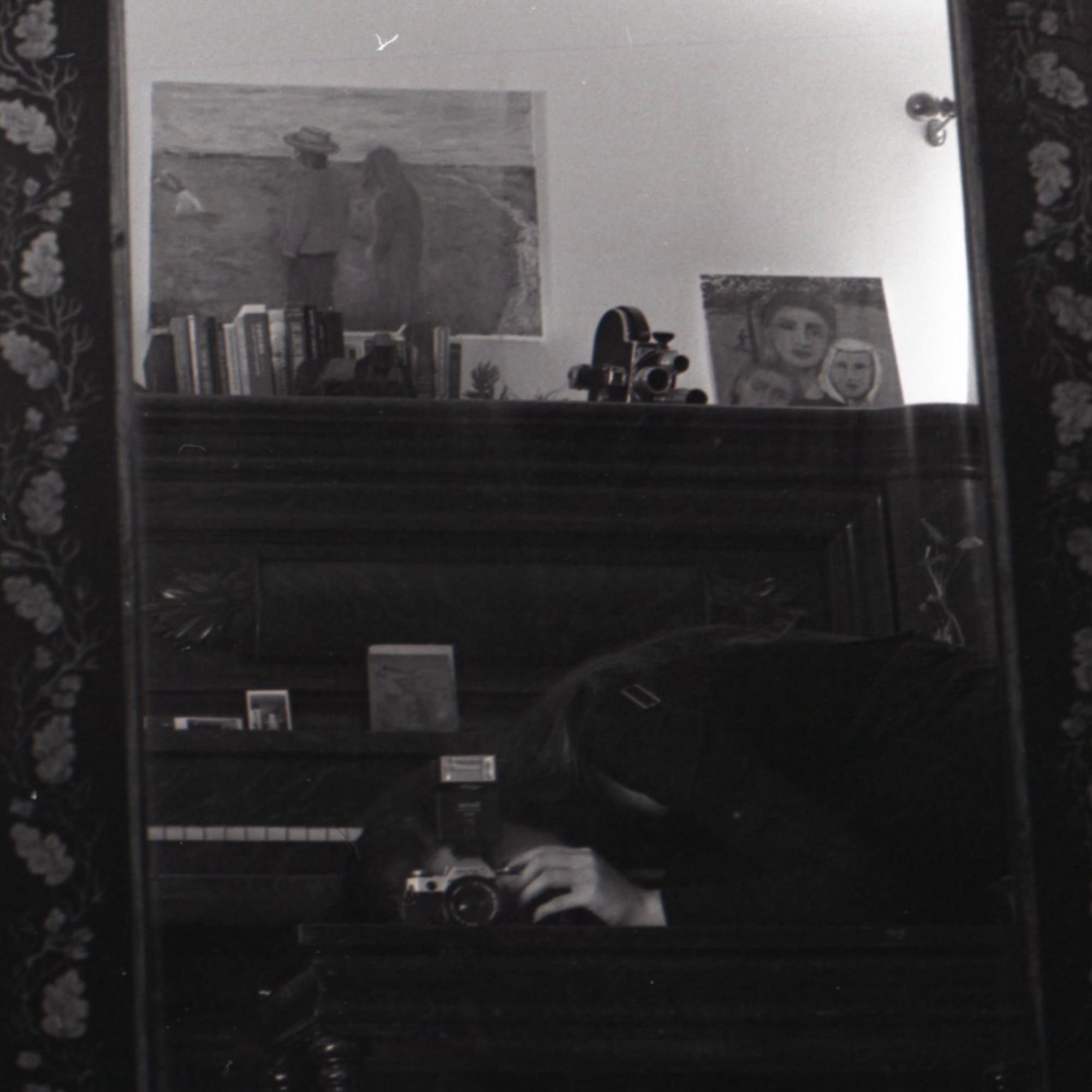
Shelby Natasha's sound is a breath of fresh air in a cluttered space. Blending elements of Chinese folk, R&B, lo-fi beats, and serene vocals, Natasha offers a new way to call love in and also pay tribute to the love that came before.
Meditative and poignant, her new EP, It Was Mine, feels like drifting on a lake or a stroll among the cherry blossoms. It's the epitome of springtime. The artist's work is soothing and soulful, and indicative of a peace and inner knowing that comes from the experience of love and loss. From start to finish, Natasha takes listeners on a vulnerable journey of her life.
The album opens with the flowing waters and birdsong of "Salmon Song," a dreamy ode to the poetry anthology I Sing the Salmon Home by Washington State poet laureate Reina Priest. Off the bat, Natasha leads listeners in prayer with her lyrics,
I was raised by a garden
I pray to the willow trees
In the schoolyard of silence
There’s music in everything.
After that, the music continues to flow with "spring," which centers on love in an apocalypse. Aren't we in the middle of one now? Then, with "pirates," Natasha memorializes her late brother through interspersed audio of childhood movies and her haunting voice. Natasha also sprinkles in nods to her brother's love of Motown classics.
The title track, as the album's centerpiece, unites the sound of the Guzheng with the cello (Clark), upright bass (Jordan Tan), guitar (Marco de Carvalho), and drums (Josh Pehrson). Created through Seattle's Bushwick Book Club, an organization that crafts songs inspired by books, "It Was Mine" was derived from Violeta by Isabela Alonde. The song processes the passing of Natasha's grandmother, and according to the artist, "almost every line is a mix between a prayer and a promise to myself."
Violeta, at its core, is through the eyes of a resilient woman "whose unforgettable passion, determination, and sense of humor will carry her through a lifetime of upheaval." The entirety of It Was Mine embodies this spirit and is a major promise of what's to come, even if rough waters are ahead.
In "Salmon Song," Natasha reminds us that there is music in everything. Her capacity to transmute her own experiences, literature, and nature into song is something to behold, making her an artist to watch.
The It Was Mine EP is now available on Bandcamp and all streaming platforms as of April 3rd, 2026.
Natasha's next show will be at Washington Hall, on April 17th (Tiered ticket prices; tickets HERE).
For more information about Shelby Natasha, visit her website.

Heavy Bloom "Woke Up" With a New Single
Heavy Bloom's new single "Woke Up" feels upbeat on the surface, but the wistful lyrics embody the essence of a relationship splitting into two different paths.
Heavy Bloom's new single "Woke Up" is deeply relatable. I've experienced a relationship that I knew had an expiration date. There's that inexplicable feeling of love, but there's always that dread in the pit of your stomach when you know it's on the outs. The band's co-leads Jeannie Marinella and Joji Harada portray increasingly distant lovers on screen for a song that captures the essence of a couple preparing to go their separate ways. The music video, filmed at Marinella's former teen hangout in Capitol Hill, was directed by Jay Jackson.
The single follows "AIEW" (All I Ever Wanted), a pensive R&B song that celebrates the beauty of connection. For their latest release, Heavy Bloom veers in the opposite direction.
"Woke Up" feels upbeat on the surface due to its fast-paced, poppy beat interlaced with a punchy bassline and light-hearted vocals, but its lyrics are more melancholy, indicating the realization that the person you love isn't quite the same anymore. There's always the question of whether it's all in your head, but it rarely is...
"Woke up early Sunday by mistake, never thought I’d feel any better..."
"You used to think that I would be the one for you..."
Heavy Bloom is also made up of Cory Hamada (bass), Demarcus Baysmore (drums), and Jacob Martin (guitar). The band, first formed by Marinella and Joji Hamada, has come into its own over the past two years, appearing at stages at Capitol Hill Block Party, Fremont Fridays, and Bite of Seattle. Known for its funky grooves, retro vibes, and energetic songs, Heavy Bloom is a band to look out for in the near future.
Heavy Bloom plans to release their first LP within the year. They previously released an eponymous EP in 2023.
For more information about Heavy Bloom, visit their website heavybloom.band and Instagram.

Paul Solger and Duff McKagan Team Up for "New American"
Pacific Northwest punk and hardcore icon Paul Solger joins forces with Duff McKagan for "New American," the first single from his timely upcoming solo record, '20 Years M.I.A.'
Punk is alive and well, and a complete necessity under the current presidential administration. While the United States is facing an unprecedented political reckoning, we're seeing new voices emerge as well as some familiar faces who are urging citizens to face the music.
In "New American," the first single from punk and hardcore icon Paul Solger's first-ever solo album, Solger and fellow rock & roll giant Duff McKagan eviscerate the current state of America from the perspective of the Red Pill crowd and MAGA loyalists. McKagan takes over lead vocal duty while Solger lays down the riffs. Meanwhile, Dejha Colantuono performs backing vocals.
Solger throws the lyrical punches with lines such as "Like the Good Book says, 'Earth is flat and snowflakes gotta die,'" and "I got a Facebook ad for some tactical pants... Put it on my credit card, 10 easy payments."
If this is a preview of what's to come, listeners are in for a timely treat.
The single was produced by Josh Evans (Pearl Jam, Brandi Carlile, Soundgarden) and Stone Gossard (Loosegroove co-founder). The accompanying visuals were directed by Regan Hagar (Loosegroove's creative director and label co-founder).
Over the course of his 40-plus-year career, Solger has played for his eponymous band (one of Seattle's first hardcore punk bands), The Fartz, 10 Minute Warning, and the Fags. Surprisingly, 20 Years M.I.A. is Solger's first independent effort. Following a string of losses, illness, and an overall hiatus, Solger is eager to get back to the stage and share his music with equally eager fans who have awaited his return.
Solger and his contemporaries inspired many up-and-coming musicians, including current collaborators Gossard and McKagan. Bands like Solger paved the way for what many people identify as grunge.
In his latest work, Solger is channeling his own inspiration from early punk greats such as the Stooges, The Dolls, The Ramones, The Germs, and more.
The journey to Solger's first album has been a long one, but it's at just the right time.
Paul Solger's new album, 20 Years M.I.A., is set to be released on May 8th, 2026, through Loosegroove Records.
The album is available for pre-order here.
EDIT: An album release show for 20 Years M.I.A. will be held at The Clockout Lounge on May 23rd, 2026. ($24; Tickets HERE).
