
Personal
Seattle Times Aftermath and What's Next
I reflect on my profile in The Seattle Times, affordability as an artist, the city's music community, and what's next for me.
Over the past week, I somehow ended up on the cover of a Sunday edition of The Seattle Times. I absolutely did not expect it. In the wee hours of the morning, I checked the paper's digital version. My stomach was tight with anticipation, and when the final publication was revealed, I gasped and immediately cried.
The tears weren't of joy; they were of anxiety. I felt like I was naked and exposed in the town square. When I first submitted to The Seattle Times' call for experiences on surviving in the city, I thought I would be a passing sentence among a chorus of voices. However, I was told I'd be profiled. At that point, I was thinking I'd be somewhere in the back, wedged between some grocery store coupons. Then, later, I was frozen in time on the front page under the headline, "LIVING IN SEATTLE ON $60K COMES WITH UP TO 7 ROOMMATES."
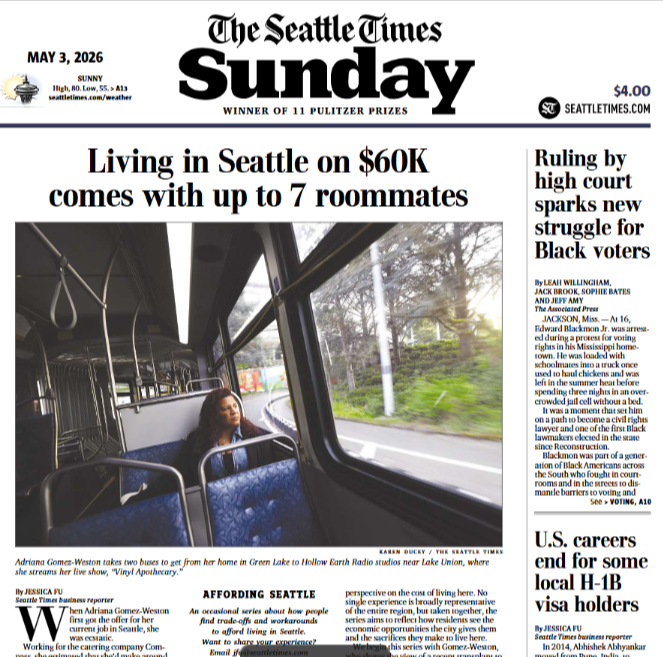
Yeah, it is true, but it felt so sobering seeing it in actual words. The last thing I wanted to be was seen as "needy." Actually, I think a part of me was afraid of being seen at all. A lot of times, I associated visibility with feeling small and vulnerable.
As the morning rolled in, I decided to send the links and screenshots to my closest family and friends anyway. Right away, everyone was supportive and really excited. They didn't seem to care much about the headline, more that I was speaking out about the cost of living and being a creative. My sister helped calm my nerves, and I allowed the story to unfold.
The past week has been interesting, to say the least. I saw the article travel online, reposted on the Seattle Times' socials, by my favorite record label, local colleagues, civic organizations, and even Seattle's mayor, Katie Wilson. For the most part, the responses were positive (with the occasional boomer criticisms). People sent me words of encouragement, housing leads, comped show tickets, and overall agreement with the state of Seattle's creative economy.
Sadly, Seattle's cost of living has skyrocketed, making it difficult to build a life as a creative. The city prides itself on its contributions to pop culture, namely music, but it has sidestepped what made all that possible in favor of the tech industry. The music industry here, specifically, is chock-full of talent and wonderfully diverse, but woefully underserved and underpaid in most cases. And even worse, many people considered music pioneers and cultural contributors are struggling to make ends meet themselves, many moonlighting at some unremarkable day job.
I can't say it's a relief that a lot of people are in the same boat, but it made me feel less alone in my struggle. For the working-class artists, it's like we're all playing hot potato with the few dollars we make. There's also this knowing between all of us. This week, more than I have felt in a long time, I was seen.
Regardless, since I've moved here, and even more now, I've been moved by how the creative community has come together. I had a lot of conversations this week about affordability, music, and life overall. It somewhat cured my perpetual wallflower status. I feel like I've been hiding in plain sight until recently, since I never wanted to be a "bother" in any way, and often preferred to observe the rooms I was in. I learned that most people are amiable and welcome enthusiasm and conversation.
After the whiplash of the past week, I've begun to think about my needs and what's next for me and Vinyl Apothecary.
I am still tethered to my own day job (catering for a major tech company), but I've been trying to make more time for writing and radio. Luckily and not luckily, work is going into a busy season, so I am making more money. However, I have a lot less time to manage. I've been wanting to allow my body more rest. I've been struggling with chronic inflammation and pain, which directly impacts my creative work.
As for Vinyl Apothecary, the radio show, I am going to focus more on creating mood mixtapes for Hollow Earth Radio. As of now, I only have the capacity to release one interview a month. I am a one-woman operation, and while I enjoy conversing with fellow creatives, interview episodes are an intensive process, and something I feel needs to be aligned given the message of Vinyl Apothecary. And as far as where my energy is best spent, I feel my writing needs to take precedence.
I love long-form writing, and plan to do more deep dives, music memories, and written interviews with working-class creatives.
On top of that, I recently co-hosted an open mic for Hollow Earth Radio and hope to do it again soon. I would love to cultivate more in-person spaces where people can express themselves safely. "Safe Harbor Open Mic" was born as a way to share art without the pesky FCC guidelines.
As far as the rest of my journey, I don't want this to be my story forever. I am glad this will be the first time many people learn of me, but it's only the beginning. I don't want to be reduced to a headline or a poster child of Seattle's struggle. It's just a fraction of my story, and a sign of how far I've come.
Although I am tired, I do feel reinvigorated in my own journey. I've been hesitant to use my voice, but I realized it's important to speak up and keep talking. So, I'm hoping you keep listening (and reading).
Thank you for the support.

Temple of the Dog and Turning Grief into Something Beautiful
Prompted by a class called "Mixtape Memoirs," I've begun to revisit some of the music that has shaped my life. For the first time, I write about my Seattle relocation following profound trauma and grief, and then how Temple of the Dog pointed me in the right direction.
“Remember, you just got out of a cult. A lot of feelings you have are a product of your three years there… Keep telling yourself this. I promise it will get better.”
Recently, I finished a class titled Mixtape Memoirs. For the first time since my move to Seattle, I'd written (and spoken) openly about my relocation. It's never been easy to talk about, but I've finally grown more comfortable with putting my experience into words. However, it's still very hard to define. How do you define the undefinable?
For nearly three years, my life in Seattle has been an exercise in transmuting grief, anger, and joy into something new. I've been in bloom, a constant work in progress, for quite some time. My healing process has been aided by reintroducing myself to the concept of community, and also a lot of great music along the way. So, naturally, a Mixtape Memoir class called to me. I've been wanting to tell my story, and it's only fitting that I do so through the songs that defined me.
Following the last session of my Mixtape Memoir class, I joined a new friend for a spontaneous karaoke adventure in Columbia City. We sang along to Alanis Morissette's "You Oughta Know," and while it was vocally distressing, it was cathartic singing at the top of my lungs with other strangers. My last relationship ended a while ago, but I felt the betrayal and angst that Alanis so expertly conveyed. I found it incredible that in a moment, I was purging emotions with a crowd of people I didn't know, alongside a new friend, who is also learning to write out her grief.
After my night ended, I continued to think about the soundtrack of my life. For some reason, in class, I was apprehensive about naming local music inspirations. Once upon a time, they were larger-than-life figures far, far away. Now, they exist somewhere nearby, now close to where I also call home. I'd named a couple of songs for my final assignment, but I'd left a glaring void. For a 10-page piece, it's nearly impossible to cover everything.
While I sang karaoke, I was reminded of some other music that meant a lot to me, and another special moment prompted by Temple of the Dog.
I relocated to Seattle from Los Angeles County on July 12th, 2023. I left a strange, high-control environment, some may call it cult-like. Following three years of constant pressure, emotional abuse, and exploitation, I was trying to figure out my place in the world again. My first months in Seattle were among the most taxing and incredible of my life.
Free from any major work obligations (besides a part-time editing gig), I was able to roam about the city and finally enjoy things I loved again. I didn't have an exact purpose for relocating to Seattle. I mainly just wanted to rest and exist without any strings attached. I was also fueled by a desire for a clean slate and a place that wasn't as chaotic for me. For years, I'd been in love with the whimsy and greenery of the Pacific Northwest. I loved the music too, but saw it as a perk. After talking myself out of moving to Portland, I saw Seattle as the next adventure.
About two weeks after I arrived, I saw that one day, there was a Brad record signing at Easy Street (for their final album In the Moment That You're Born), and the next day was The Rockfords' first live show in over 20 years at the Showbox. As a Pearl Jam and Northwest music fan, it was a dream come true. And naturally, the events drew a bunch of Pearl Jam pilgrims from all over. However, I was still nervous since I was a baby in the city. Luckily, an online friend connected me to someone who traveled to Seattle for the weekend. Strangely enough, I had stood behind this woman at a Painted Shield show just a couple of months earlier. I didn't know her then, but music would bring us together once more.
After standing like cattle for slaughter for some signatures, I came back to Earth. I couldn't believe I looked dead into the eyes of people I admired and managed to get any words out. I was too awestruck to even ask for selfies, as my friend did before me. A lot is a blur, but I remember after I gushed, there was a sweet, genuine smile, "Thanks for listening," and then continued the human conveyor belt.
After the Brad signing, my new friend and I were invited over to Talerico's for pizza and karaoke. I didn't really know anyone else, but I knew that we all shared a love of the same band. Everyone was friendly and welcoming, and very excited about my newness. We all squished at a table together and took in the hilarious sights of drunk people belting out top 40 tunes.
One of the women in the group chose a song for us to sing. Not surprisingly, she chose "Hunger Strike," a karaoke favorite among grunge fans. We needed to sing "Hunger Strike" for some reason. And similarly to when I sang along with Alanis, I nearly broke my vocal cords trying to teeter-totter between Chris Cornell's impassioned high notes and Eddie Vedder's gravelly crooning. We sounded horrific, but it was a beautiful moment all the same.
The same woman who selected the song stated she would send the video to a certain someone for a specific reason. She insisted it was a "surprise." She typed all of our names and delivered the video of our botched version of "Hunger Strike" to her friend. She needed him to see our singing.
The very next day, that someone would go on to sing solo on stage for the first time. That song happened to be the first glimpse of his rock opera, his years-long manifestation of grief, love, community, and music. And then, I realized we‘re all dealing with our own pain in our own ways. We all wear grief differently.
It was an oddly poetic moment, and one that reminded me that I was going to be OK.
Some of those people in my group I would meet formally later. And now, nearly three years after my move, I’ve been creating again. For a really long time, I stepped away from writing or any sort of creative output. I had been surviving for so long that I lost myself and my purpose.
I've spent a lot of time pondering grief, music, and how something beautiful can arise from those things. As far as my life and all the people I have encountered, I still struggle to define anything. Yet, I've thought that what defines a person is not the shitty things that happen to them. What defines a person is what they choose to do with the grief that seeps through the shit. Grief is a fertilizer. You can either let it collect and stink or use it to grow something new, maybe something that will nourish others.
Often, I am reminded of Temple of the Dog and the beautiful music that arose following an insurmountable loss. Released in 1991 after a two-week recording process, it's one of the most profound examples of what happens when you channel grief and use that to fertilize a whole garden of joy. 35 years later, people still sing "Hunger Strike" off-key in bars, shout in a crowd of people to "Reach Down," or cry in solitude to the poignant lyrics of "Say Hello 2 Heaven." That garden still sustains millions and has even multiplied many times over.
Temple of the Dog (the band and the record) exists as a testament to the beauty of Chris Cornell and Andrew Wood, and also the healing power of music and art as a whole. It helped me to re-envision what it means to go on after the undefinable happens. And through time, I’ve fallen in love with Seattle and the camaraderie of the community here. Constantly, I see examples of people who have chosen to still create and have also chosen beauty and kindness despite the tragedy, obstacles, and even cruelty hurled their way.
Two months after my West Seattle karaoke adventure, I would finally pay a visit to Discovery Park for the first time. It took a while to build up the strength to make the hike, and I wanted it to be meaningful for my first time. Although I had moved to Seattle in July, I was still dealing with the fallout of leaving my toxic situation. I had hit a mental low and questioned my existence. I hid behind cinematic "I made it posts!" but each day was a struggle to live.
The "Hunger Strike" video inspired me to make the pilgrimage to Discovery Park, as so many others had. To many (or maybe me), the video embodies a release. I decided to orchestrate my own, even though I can't sing or play instruments.
The trip to Discovery Park takes nearly an hour by bus, and the endpoint is a nearly 40-minute walk from the nearest bus stop. It's not for the impatient, and it's not for a quick trip or photo op (at least in my case).
For me, the trek was arduous and painful, but when I reached my destination, it was worth the effort. There was a beautiful view of the bay, and a few boats floating by. There was barely anyone there, ideal for an introvert looking to mull things over. The air was peaceful, and the winds were still.
While I rested on the beach, I decided to revive a ritual from my youth ministry days. I sat in solitude, meditating as the waves crashed. When I came to, I pulled out a paint pen and selected rocks to write on. With the pen, I wrote on each rock something I needed to release. There were a lot of rocks, and I purposefully picked some heavy ones. Then, after uttering affirmations to myself, I cast my pile of rocks into the ocean, allowing them to be swept away.
After that, I chose to move forward and was reminded that, in times of trouble, you can break through.
I saw you swingin', yeah, swingin' your mother's sword, ooh
And yeah, yeah, yeah, I know you're playin', but oh, sometimes the rules get hard, oh-oh-oh-oh-oh
But if somebody left you on out on the ledge
If somebody pushed you, you're over the edge
If somebody loved you and left you for dead
You gotta hold on to your time and break through these times of trouble
